Monday, January 16, 2006

Hollywood and World War II


“Escapist fare was the general order of the day, but Hollywood was aware too of the need for films extolling the virtues of democracy and exposing the horrors and savagery or totalitarian regimes. America’s motion picture industry rose to the task of tending the spirit of a nation during a perilous time in its history. Here is how Hollywood went to war…”

The story of Hollywood’s relationship with World War II is an extensive one. There are hundreds of films depicting the war at home and abroad, yet because there are so many war films that cover not only World War II but every other war since then, people today take for granted that it was not always easy to produce and release a film about war. The subject matter Hollywood wanted to tackle in the 1930s was more often than not out of sync with what the government and the censorship boards had in mind. This was particularly true of content relating to the war because the United States had a very tumultuous relationship with the rest of the world, and the American people were extremely wary of how the war was going to affect them. In other words, as tempting as it was for Hollywood studios to project onto the movie screen what was happening overseas, in the late 1930s the obstacles seemed insurmountable. Yet because such a great canon of World War II films exists, we know that Hollywood did overcome these obstacles. Placing side by side the following statements shows the significant shift that occurred from 1938 to 1941 regarding the motion picture’s role in portraying the war. The first is from Will Hays, President of the Motion Picture Producers and Distributors of America. The second is from Wyoming Senator Joseph C. O’Mahoney.

“[March 28, 1938] The function of the entertainment screen is to entertain by whatever wholesome theme or treatment writers, artists, and dramatists can create. There is no other criterion.”

[June 1943] “We are living in a new age in which the radio and the motion picture have become the most effective means of disseminating news and factual information.”


More important than the shift itself, however, is what factors contributed to the shift. Examining a brief history of censorship, Hollywood foreign markets, pre-war Hollywood filmmaking, the isolationist cause, the relationship between the studios and the government, and finally the relationship between Hollywood and its audience, it is possible to determine how the film industry was able to convince the censors, the isolationists, and the American public that the war picture, like any other motion picture of the day, deserved a place on the movie screen.

Censorship Rears its Ugly Head: Hollywood in the 1930s

The 1930s are often considered the “Golden Age” of Hollywood. Motion pictures still reflected the glamour, decadence, and sexuality of the 1920s, and with the emergence of sound, cinema took on a whole new life. Due to the depression, the industry felt it important to give American audiences escapist fare to help them through the grim reality of the time. “The dominant theme of American movies in the golden age, said critic Parker Tyler, was the ‘success story.’ The movie makers projected their success on the screen to a public that wanted to believe.” Not everyone seemed as eager as Tyler suggests to embrace everything Hollywood was spoon-feeding its audiences. “Worry about the effect movies might have on public morals, particularly those of children…was a recurrent concern.” In 1930, Hollywood agreed to abide by a production code written by Daniel Lord, but the studios tended to ignore the code as is evidenced by the films they released, particularly in 1934. These included Cleopatra, Ecstasy, Murder at the Vanities, I Am a Fugitive from a Chain Gang, and Scarface. The films depicted—albeit with great subtlety—sexuality, drug-use, the breakdown of law and order, violence, slavery, and social disobedience.

Not surprisingly, Hollywood was attacked from the outside. In 1934, American bishops of the Roman Catholic Church threatened to boycott the industry. Will Hays, head of the Motion Picture Producers and Distributors of America (Hays Office), and some alarmed movie executives feared that “unless the trend in pictures was curbed, the federal government would step into censor the movies or break up the industry.” Consequently, Hays upgraded the enforcement mechanism, the Production Code Administration and made Joseph Ignatius Breen, a conservative Catholic journalist, the head of the administration. Films had to conform to Breen’s interpretation of the code to get a PCA seal. Without the seal, none of the Big Eight studios would handle a film, which would effectively kill its market. Because of the code, the subject matter Hollywood would undertake from 1934 to the 1950s was sharply limited.

Industry policy was particularly sensitive about films dealing with foreign counties. This proved to be a major hurdle, as Hollywood grew more and more tempted to fictionalize the European crisis. “Although the Hays Office tried to steer the studios away from political subjects, the movie producers, whether for reasons of conscience, profit, or sheer human interest, could not avoid politics and war.” Besides pressure from censorship boards, Hollywood also felt pressure from abroad. The American movie industry was economically dependent on a world market for the success of its products. In Latin America, for example, some 5000 theaters played American films; in Asia, more than 6000. Europe had by far the greatest number of all—more than 35,000 theaters where American movies were shown. Because of this dependence on foreign markets, Hollywood had to be extremely careful in the way they handled world affairs and especially in the way they depicted foreign leaders. “Any movies that dealt realistically with Mussolini and his new Roman Empire, Adolf Hitler and Nazi Germany, or the Spanish Civil War, were likely to be banned from thousands of screens in Europe while at the same time being opposed at home by American isolationists. It was a cruel economic choice the movie makers faced, since forty percent of industry revenues were generated overseas, representing the profit margin for many films.” Eventually, the complete intolerance of American films and film practices sealed Hollywood’s fate in dealing with foreign markets. “The Nuremberg Laws banned films with Jewish actors and actresses, cut the number of American pictures that could be shown in Germany to just twenty per year, and imposed severe restrictions on the repatriation of profits…As the stain of Nazi influence seeped across Europe after 1937, Hollywood’s markets progressively dried up. By 1940 they were insignificant.” Because the film industry no longer had to concern itself with whether or not a film would play in Europe successfully, subject matter became a much less sensitive issue to the studios. In fact, several studios began to make explicitly interventionists films. Joseph Breen was deeply suspicious. Breen knew that many of the studio executives were Jewish and was concerned that they were trying to use the Nazis’ treatment of Jews to make propaganda pictures. The issue of Nazism in Hollywood would become a particularly hot topic when America’s favorite comic star decided to take on Adolf Hitler himself.

How The Great Dictator Found Its Way to the Screen

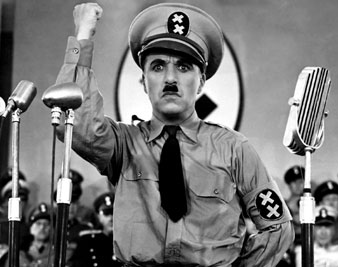
“The credit for perhaps the most significant antifascist film, both politically and artistically, must go to Charles Chaplin, independent producer, director, writer, and actor extraordinaire, for his 1940 classic, The Great Dictator.”

Although The Great Dictator was released in the fall of 1940, controversy surrounding the film began much earlier. In October 1938, the German council in Los Angeles wrote to Joseph Breen objecting to the proposed picture. In March 1939, Brooke Wilkinson, secretary of the British Board of Film Censors, cautioned Breen that there would be a serious problem if Chaplin made The Great Dictator, because the board enforced a stringent rule that no living personage could be represented on the screen without his or her written consent. Chaplin was thus pressured to cancel the project. He said studio execs at United Artists had told him “they had been advised by the Hays office that ‘I would run into censorship trouble.’” Chaplin was not discouraged and continued with the production. He fully believed that Hitler should be ridiculed. It is fairly certain Chaplin would have done anything to get the film released; however, the outbreak of war in September 1939 relieved the British censor of the need to enforce its censorship rule, which took pressure off Breen to shelve the project. Chaplin completed The Great Dictator over the summer of 1940. Breen, delighted with the film, screened it on September 6. “‘It is superb entertainment,’ Breen wrote, ‘and marks Mr. Chaplin, I think, as our greatest artist.’”

While The Great Dictator was well received, it is important to note why exactly people could handle this kind of “war film” in 1940 and not others. Through 1941, it was required that Hollywood films distinguish between Nazis and the German people. For example, The Great Dictator drove home the point that not all Germans were Jew-hating Nazis. “This approach was both a Hollywood formula and a requirement of the production code. Evil Germans had to be balanced by a few good Germans. The PCA simply took its formula for avoiding controversy—politicians could be corrupt, but not all politicians were—and applied it to Nazi Germany.” The PCA demanded that Hollywood enforce a fairness doctrine, despite how evil Hitler and the Nazi regime were considered to be. Besides The Great Dictator’s “fair” representation of Germans, the film was satirical and Chaplin, the comic genius, was in top form. Chaplin had made a name for himself as a silent screen star and Dictator, being his first sound film, allowed Chaplin to expand even further as a performer. By filtering the idea of Hitler and Nazism through the lens of comedy, Chaplin was able make his own unique political statement.

Even though the critical response of The Great Dictator was generally good, it was that unique political statement that people found to be the weakest element of the film. The general consensus seemed to be that Chaplin succeeded as a comedian, but not as a politician. Critics did not care for the closing speech in which Chaplin makes a passionate plea for tolerance. Breen did not object, perhaps because “the speech expressed a universal longing for peace rather than a specific political course of action.” Critics, however, thought it was inappropriate and superfluous. Bosley Crowther of the New York Times said, “It is as the dictator that Chaplin displays his true genius,” but later added, “The speech with which it ended—the appeal for reason and kindness—is completely out of joint with that which has gone before.” John O’Hara of Newsweek bluntly declared, “No time for comedy? Yes, I say time for comedy. Time for Chaplin comedy. No time ever for Chaplin to preach as he does those last six minutes, no matter how deeply he may feel what he wrote and says.” Regardless of the how some felt about the ending of The Great Dictator, Chaplin turned his political statement into box office gold—“the film grossed $5 million worldwide and earned him a profit of $1.5 million.” Chaplin did not take the criticism lightly, however. When the New York Film Critics awarded him the Best Actor award for The Great Dictator, Chaplin refused it due to the harsh criticism parts of his film received. It is clear that Charlie Chaplin wanted to be taken seriously as an artist, and his intent with The Great Dictator was not solely to humor his audience. Perhaps the American public was not yet ready to have their favorite movie stars remind them about the perils of an impending war. Whether they were ready or not, one maverick director was about to let Americans know that the situation abroad could no longer be ignored.

Foreign Correspondent: Alfred Hitchcock’s Wake-up Call to the American People

“Foreign Correspondent engages its world audience on two coexistent levels. The obvious one is the entertaining chase—the cloak-and-dagger work of the New York crime reporter. The second is the flag-waving propaganda calling for an end of American isolationism in World War II.”

Alfred Hitchcock was already an established filmmaker in his native Great Britain by the time he relocated to the United States in 1939. His decision to move could be attributed to the simple fact that Hitchcock wanted more freedom and he believed American audiences would allow him that freedom. Despite what Americans were and were not willing to see, the issue of creative freedom was much more complicated as the United States was growing more involved in the war. “Strong debate about the reversal of the original Neutrality Act was the political atmosphere in the United States when Foreign Correspondent was released. This propaganda-entertainment film was part of the new vanguard of politically oriented films exposing the Nazi menace while calling for military alertness through rearmament.” So with the war moving closer and closer to the forefront of American life and the growing concern people felt toward propaganda and politics in film, how exactly was Foreign Correspondent able penetrate the market?

While it is true that Hitchcock did not blanket his film with comic relief, Foreign Correspondent appealed as a political thriller that incorporated a lot of exciting action sequences and a romantic storyline. Joel McCrea plays Johnny Jones, a newspaper reporter who is sent to Europe to report on the escalating foreign conflicts of the nations at war. There is an espionage subplot involving a Dutch diplomat who is captured by the Nazis after attempting to deliver a secret treaty back to his country. Laraine Day plays an English girl who gets involved romantically with Johnny as they struggle to rescue the Dutchman. Just as Chaplin was the king of comedy at that time, Hitchcock was the master of suspense. And like Chaplin, Hitchcock had an uncanny ability to create the kind of movie audiences wanted to see despite the subject matter. Although Hitchcock and his writing team took great pains to make the film as socially relevant to the time as possible, they were able to package it in such as way as to not make any blatant or offensive political statements. “The film had no problem getting a seal of approval. All references to Spain were removed, and German policy toward the Jews was not dealt with. The picture did not directly attack the Germans or imply that all Germans were evil…While Breen and Hays might have preferred the film not be made, Foreign Correspondent was mild enough to cause little concern.” Critical response of Foreign Correspondent was also remarkably positive. “Time magazine claimed Foreign Correspondent to be ‘one of the year’s finest pictures; noting that Hitchcock’s camera was the best reporter—being in the right place at the right time.” The New York Herald Tribune concurred. “The ending of the film is as challenging a call to arms as the screen has issued to democracy.” With approval from the PCA and a warm reception by the critics, it would seem that Foreign Correspondent was able to escape controversy altogether. That would prove not to be the case, however, when the isolationists got wind of it.

As with The Great Dictator, it was difficult to ignore the message being communicated by the conclusion of Foreign Correspondent. Hitchcock was British, after all, and it was obvious that he felt some misgivings about how successful his country was going to be against Germany without some kind of American militaristic intervention. “The film ended with McCrea, caught in the London blitz with bombs falling in the background, making a passionate plea via radio for American intervention before the lights went out all over Europe.” While many people considered the film patriotic because of its emphasis on coming together for the common goal of democracy, “the isolationists viewed Foreign Correspondent as propaganda because it attacked non-involvement.” At the 1941 hearings investigating propaganda in Hollywood, the film was referred to several times. The interventionists used it in their defense and argued that motion pictures were simply illustrating the reality of the times. Darryl F. Zanuck, Vice President of Twentieth Century Fox said, “Hollywood didn’t create the underworld, nor did it create Hitler and the Nazis. We have portrayed them no differently than they are pictured daily in newspapers, magazines, books, and all other mediums of expression.”

Foreign Correspondent
is an important film in Hitchcock’s career because it marked the beginning of a series of extraordinary films about war, espionage, and foreign affairs for which Hitchcock would ultimately be remembered. The real accomplishment, however, is how Hitchcock was able to make and release a film with such controversial subject matter, and convince the American public that it was exactly what they needed to see.

Hollywood Under the Microscope Again

On September 9, 1941 a subcommittee of the Committee on Interstate Commerce began an investigation of “war propaganda” and motion pictures. The Hollywood studio heads faced serious charges as isolationists accused them of embarking on a “devious campaign to inject its entertainment pictures with propaganda and drag America into the war.” The purpose of the hearings was to determine whether Congress should enact legislation to deal with content in motion pictures. Wendell Willkie, the 1940 Republican presidential nominee who had become a supporter of FDR’s international policies, served as counsel for the industry interventionists. He charged that the real purpose of the hearings was to gain publicity for the isolationist cause. Senator Gerald P. Nye, an extreme isolationist from North Dakota, was the committee’s first witness. He attacked Jewish control of the industry and “claimed to think it was ‘quite natural’ that American Jews would support a foreign policy directed against their oppressors.” Willkie fired back by pointing out that within the industry there were “Nordics and non-Nordics, Jews and gentiles, Protestants and Catholics, [and] native and foreign-born.”

The industry defended itself in several ways. First and foremost, it reverted to its time-worn excuse that it was purely in the business of entertaining. Yet, as it became clear that the hearings were not designed to analyze movies but curtail interventionism, the defense shifted its gears. Isolationists were bent on making connections between FDR’s foreign policy and the motion picture industry, so in effect, they went after Hollywood as a way to protest the government. The industry execs thus took it upon themselves to dispel any kind of connection. Willkie stated, “‘the motion picture industry and its executives are opposed to the Hitler regime…we make no pretense of friendliness to Nazi Germany.” In other words, Hollywood’s anti-Nazi films were not propaganda but accurate portrayals of what was happening overseas. Willkie’s decision to abandon the weak “nothing but entertainment” argument was a brilliant one as he converted the issue from propaganda to a question of fact. He understood that most Americans, although fearful of America’s involvement in the war, detested Hitler and agreed with the way Nazism was represented in the movies. Because Hollywood was handling mildly what the print media had already handled explicitly, Willkie made a convincing argument that movies should be entitled to the same freedom from federal censorship. “By claiming that the industry was producing portrayals of the ‘world as it is,’ he wrapped the studios in the flag of patriotic service. Hollywood emerged as the unlikely hero.” The hearings were adjourned on September 26. On December 8, 1941, D. Worth Clark, the isolationist Democrat who had headed the subcommittee, announced their abandonment. Now that the United States was directly involved in the war, the issue of interventionism was moot. The next big question became how motion pictures would handle the war, and whether or not Hollywood and the government could work together to create the kind of war picture people would be willing to see.

Can Propaganda Be a Good Thing?

Because of what had happened during World War I, many Americans had serious misgivings about the role of propaganda. In 1917-18 the Committee on Public Information, better known as the “Creel Committee,” launched a propaganda campaign unlike any other in U.S. history. The campaign flooded the country with posters, pamphlets, and “four-minute men,” who gave rousing patriotic speeches in theaters and other public places. What stood out more than anything else, however, was the “hate the Hun” campaign that distorted the perceptions and contributed to the persecution of German-Americans. It also heightened the disillusionment already felt by Americans after the war. People also felt wary because of suspicions regarding British propaganda’s role in maneuvering the United States into war in 1917. For these reasons, Hollywood was apprehensive about producing war films because of the propaganda stigma that would inevitably be attached to them.

FDR and his administration were also unsure of how they should handle the propaganda situation. “When the war broke out in Europe on September 1, 1939, the United States was the only major power without a propaganda agency.” FDR did finally create a propaganda agency in late 1939 called the Office of Government Reports (OGR) but this agency was limited to gathering information about the defense program and informing the executive branch about public opinion. In other words, the agency dealt only with accurate and neutral information. The head of OGR was Lowell Mellett, a presidential assistant and former editor of the Washington Daily News. Despite its informational focus, the agency aroused considerable controversy and Congressional conservatives refused to fund it. Roosevelt used his own office funds to operate the agency until Mellett successfully defended his budget request to Congress in 1940, and OGR became a fully funded part of the defense effort.

FDR took another tentative step in March 1941 when he signed an executive order to create a Division of Information within the Office of Emergency Management (OEM). This agency again dealt only with informational propaganda. While trying to avoid backlash from isolationist groups, the government managed to stir up criticism from interventionists who argued for a more “inspirational propaganda agency.” “They argued that conscription, the recently passed Lend-Lease bill, and a military buildup were not enough.” By the fall of 1941, the propaganda issue had a new critic. Army Chief of Staff George C. Marshall complained of low morale among draftees, which he contributed to apathy of the general public. FDR responded by placing the responsibility of morale-boosting functions in a newly formed Office of Facts and Figures (OFF) headed on a part-time basis by Archibald MacLeish, the prominent poet and librarian of Congress. MacLeish claimed that the OFF’s sole purpose was to convey accurate information that would neither be “perverted or colored.” Although OFF did rely on informational methods, its practice of subtly manipulating the facts paved the way for future vehicles of “inspirational propaganda.”

If, up until this point, FDR felt an obligation to handle the propaganda situation with kid gloves, it was Pearl Harbor that allowed him to finally deal with it straightforwardly. His first step was to appoint Lowell Mellett coordinator of government films on December 17, 1941. Mellett was expected to establish cooperation with Hollywood and insure that the studios did their part to help the war effort by inserting morale-boosting themes in its films. Thus began a somewhat unsteady give and take between movie producers and government propagandists. Mellett believed that the studios would cooperate with the propaganda program but only if the government did not interfere with the box office. Yet, the situation was sticky because while the government needed Hollywood, “too much propaganda could wreck the movies’ entertainment appeal—the very thing that made the studios attractive to the propagandists.”

In April 1942, Mellett established a Hollywood office, and heading the branch was Nelson Poynter, publisher of the St. Petersburg Times and close friend of Mellett. Poynter did not follow movies but Mellett thought his political understanding was more important than movie expertise. The office came under the Domestic Branch of the Office of War Information (OWI) when it was created in June 1942. The presidential order instructed OWI to “undertake campaigns to enhance public understanding of the war at home and abroad; to coordinate government information activities, and to handle liaison with the press, radio, and motion pictures.” At first, OWI simply assisted Hollywood in the production of government and war-related shorts to be shown with feature films in theaters. Yet, Poynter downplayed the informational short and felt that the government’s message would be most effective if incorporated into feature films. OWI could thus become most helpful if it got to review scripts before production began.

While Hollywood was perfectly willing to produce “four-to ten-minute information films on victory gardens, rubber conservation, or tank production,” it was not so enthusiastic about releasing entertainment features with explicit propaganda themes. Sensitive to the government censorship that had burned the industry so badly in the 1930s, studio executives continued to fear that by releasing any film that could be interpreted as propaganda, the government would again step in and censor it. OWI attempted to convince the industry why their approach would be successful. “Entertainment pictures presumably could reach a mass audience impervious to carefully reasoned writing. OWI believed this could be accomplished if propaganda messages were ‘casually and naturally introduced into the ordinary dialogue, business, and scenes which constitute the bulk of film footage.’” In the summer of 1942, Poynter and his staff created the “Government Information Manual for the Motion Picture Industry.” The manual asked filmmakers to consider the following questions:

1. Will this picture help win the war?
2. What war information problem does it seek to clarify, dramatize or interpret?
3. If it is an “escape” picture, will it harm the war effort by creating a false picture of America, her allies, or the world we live in?
4. Does it merely use the war as the basis for a profitable picture, contributing nothing of real significance to the war effort and possibly lessening the effect of other pictures of more importance?
5. Does it contribute something new to our understanding of the world conflict and the various forces involved, or has the subject already been adequately covered?
6. When the picture reaches its maximum circulation on the screen, will it reflect conditions as they are and fill a need current at that time, or will it be out-dated?
7. Does the picture tell the truth or will the young people of today have reason to say they were misled by propaganda?


With this manual, the OWI effectively created its own production code. Though not as scrupulous and comprehensive as the Production Code Administration’s standards, the OWI code similarly instructed filmmakers on how to present certain subject matter. Instead of being in the business of cutting out and omitting material from movies, however, OWI felt inclined to insert material that would enhance the quality and effectiveness of movies as vehicles to assist the war effort.

With the help of OWI, Hollywood began producing a steady supply of war films that succeeded in educating the public about the war, while also keeping them entertained. While the government and the movie industry would continue dealing with one another throughout the war years, one thing was clear. The subject of war had infused itself onto the American movie screen. Not only had Hollywood convinced the government that the war film was a necessity. By 1943, it had the American public begging for it.

An Audience Transformed

By 1943 it had become clear that American audiences were beginning to relinquish their paranoia and skepticism regarding war films. Whether it was because OWI’s strategy had worked on them, or Americans simply let their guard down, public opinion over the role of the war in Hollywood film had certainly changed. On January 1, 1943, a memo from “America’s Movie Audience” was sent to a variety of Hollywood and other news sources including Fox Movietone News, News of the Day, Paramount News, Pathe News, The March of Time, and Universal News. The memo listed a number of requests.

1. Give us pictures of our men and women in service…behind the lines and at the fighting fronts!
2. Show us the courage and fortitude of our Allies…Bring home to us their contribution of blood, sweat and tears!
3. Portray to moviegoers in the other United Nations and in neutral lands…how Uncle Sam “keeps ‘em rolling” in the arsenal of democracy!
4. Fight phony Axis propaganda with pictorial facts…on the motion picture screens of America and the world.
5. Give us the truth…in pictures…about the war…We can take it!


How can this reversal in public opinion be accounted for? Perhaps people realized that propaganda did not necessarily have to be a negative instrument. There were plenty of films, Foreign Correspondent for example, that could instill in people a desire to fight for something without having to resort to blatant hatred or condemnation of the enemy. When OWI was formed in June 1942, it anticipated these very ideas and took them to heart when working with Hollywood to produce war films. “OWI officials had…learned that hate propaganda was counterproductive and that something more than flag-waving emotional pitches was necessary.”

Yet, even if there still existed certain skepticism about war movies and propaganda, one thing was certain. People were going to the movies again. “After peaking in the mid-thirties, weekly movie attendance had declined in 1941 to 55 million per week, but in 1944 almost 100 million Americans—two-thirds of the population—attended movies each week, and the studios prospered as never before.” Once the United States officially got involved in World War II, Americans could no longer deny that war was the reality of the time. Hollywood and OWI understood that, although the American public had accepted its country’s involvement in the war, they were wary of it, and consequently the two groups worked together to produce the kind of film that would instill patriotism and morale rather than fear or apprehension. The result was a warm reception by American filmgoers who could once again find comfort and reassurance on the silver screen.

Conclusion

Just as it took some time for the United States to accept its role in the war, it took time for American movie audiences to accept the role of war movies in their lives. Because film was such an influential medium in the 1930s and 40s, everyone from the filmgoers to studio execs to government officials to members of clergy had a stake in what found its way into motion pictures. Combined with the hypersensitive censorship boards of the early 1930s, people’s fears over the United States involving itself in yet another world war severely hindered any chance Hollywood had of releasing films that reflected what was going in the world. With all the backlash and criticism toward propaganda, there was a time when it seemed as though the war picture was destined to remain absent from the Hollywood film canon. Were it not for the bravery and creative genius of several maverick filmmakers, the cooperation of the Hollywood movie industry and United States government, and a sudden desire in the American public for honest and rousing war films, it is quite possible that a great many of the most beloved movies in American cinematic history may never have been produced, distributed, or exhibited to a viewing public. As memories of the war fade and first-hand accounts can no longer be obtained, the stories of hardship, sacrifice, courage, and victory that came to define World War II will not be forgotten as cinema has given those stories eternal life.

Complete essay with endnotes available upon request

Tuesday, January 03, 2006

Taxi Driver*


So much of cinema has rested on the dichotomy of good versus evil. We root for the success of the “good guy” and the failure of the “bad guy.” Yet, what happens when the good guy and the bad guy are the same guy? Goals and motivation become much more complicated because we are not sure whether we want the main character to succeed or fail. While it may be frustrating to watch a film with this kind of person in the lead role, it certainly makes for some interesting cinema. It is also the reason Martin Scorsese has such an impressive resume. Scorsese has built his career around the idea of the anti-hero and even though his characters are not easily accessible or likable, they are some of the greatest film characters in American cinema history. How is this possible? The protagonists of Scorsese films are thieves, sexual predators, gangsters, and murderers. Yet, somehow we not only let them off the hook but feel sympathy for them as well.

It is Scorsese’s unparalleled ability to frame his characters in a particular context that allows him to gain the sympathy of the audience. In Scorsese’s films, the real enemy is the world. It is a cruel and unforgiving world and people do what they do in order to survive in it. While this world may be an exaggeration of the one in which we actually live, when we watch his films, Scorsese makes us believe his is the only world that matters. That being said, how we judge Scorsese’s characters involves appreciating the relationship each character has with his world so that we may better understand his thoughts and behavior. Scrape away all the layers of violence and corruption in these films, and it is possible to find individuals with the same fears and desires as the rest of us. Scorsese’s films suggest that everyone is connected, not by our good or evil tendencies, but by our common goal to survive in a world fully capable of destroying us if we let it.

In Taxi Driver, we see the world through the eyes of Travis Bickle, a disillusioned New York City cab driver. Through Travis’s eyes the world is bleak and repulsive. He sees almost everyone and everything as filthy and grotesque, and if it were up to him, he'd destroy all the things that disgust him. Yet, Travis is no vigilante. He is rather, as one of the film’s characters describes him, a walking contradiction. Travis frequents porno theatres and watches soap operas and American Bandstand even though sexuality sickens him. He prefers to work at night even though sin and corruption run rampant after dark. He buys a bunch of guns and makes speeches about wiping out the scum of the earth but at the end of the day manages only to point the guns at himself. Travis’s life is filled with inconsistencies because of his tumultuous relationship with the outside world. Even though Travis feels this disdain for the world, it is impossible for him to shut it out because he can’t bear the isolation. Travis has an equal disdain for himself because of his inability to connect to the people and places he encounters. Essentially, Travis wants the impossible: to be accepted by a world he feels has no place for him.

What Travis must do to achieve this goal is not simple and it certainly isn't pretty but that's what makes it the film's most provocative element. Travis takes it upon himself to take out a prostitution ring so that he may save Iris, a young runaway, from Sport, the man who runs the ring and who has also made Iris his concubine. Sport has stolen Iris’s innocence and thus he has committed the worst possible offense. Through his debasing of young girls, Sport is paving the way for a new generation of corruption. Travis sees the extermination as an opportunity to save not only Iris, but also the potential for a better world, and so when Travis enters the whorehouse and guns down every person he encounters inside, he does so unapologetically. The shooting spree is graphic and unrelenting, and it is further intensified by Scorsese’s decision to show it in slow motion. Yet, disguised among the bloody chaos of Travis’s killing frenzy is his ultimate redemption. In giving Iris the chance at a better life, Travis has earned his place in the world.

While it may be difficult to sympathize with the extreme nature of Travis’s behavior, we have all experienced the kind of loneliness and insecurity Travis experiences throughout the film. Everyone, at some time or another, must do what is necessary to give his or her own life meaning. Travis may be cynical about the world but he still wants to be accepted by it. When Betsy enters Travis’s cab at the end of the film and she is much kinder and favorable toward him because of what he has done for Iris, it is as though Travis has truly accomplished something. Betsy represents a world that no longer rejects Travis, but embraces him.

The real moment of triumph in Taxi Driver is not Travis’s success in taking out Sport, Betsy’s changed attitude toward Travis or even the newspaper articles branding him a hero for saving Iris, but rather the simple closing image of Travis’s eyes in the rearview mirror of his taxicab. Scorsese shot the image so that while Travis is making eye contact with Betsy who sits in the backseat, he is also making eye contact with the audience. It is a moment of true connection where the barriers of cinema are broken and we no longer see Travis as just another one of Scorsese’s anti-heroes, but as a human being just like each of us.

*Nominated for four Academy Awards including Best Actor, Best Supporting Actress, Best Original Score, and Best Picture

Tuesday, December 27, 2005

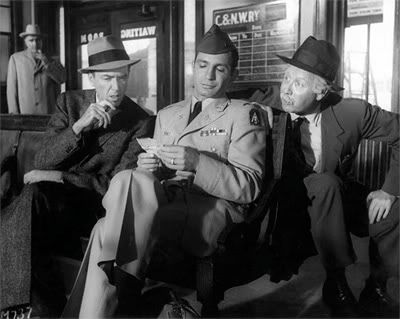
Anatomy of a Murder*


Anatomy of a Murder, released in 1959, is one of those perfect films. Great acting, a compelling script, flawless editing, and beautiful cinematography. I've been on a real Jimmy Stewart kick lately (although I'd venture to say I'm always on a Jimmy Stewart kick) and ever since I saw The Hustler, I've been completely smitten with George C. Scott. Ben Gazzara, who plays Lieutenant Manion, really holds his own next to Stewart and Scott as well. Duke Ellington's music was a fantastic addition to an already airtight motion picture. The jazz, being lenient and easygoing by nature, is the perfect complement to the strictness of the murder trial taking place at the film's forefront.

I don't always understand why some films really impress me and others, even when they are considered masterpieces, don't have much of an effect at all. I think what put Anatomy in the first category was that it was authentic. All of the characters had weaknesses which made each one equally captivating to watch. To quote Stewart's Paul Biegler, "people aren't just good or just bad...people are many things." Those "many things" are what make people and film characters so interesting and this is especially true of Anatomy's characters. I also think the film's tone is particularly noteworthy. While the story deals with serious issues like rape and murder, there is also a strong element of humor throughout. I thought the humor was one of the finer aspects of the film because it illustrated that sometimes, even in the most sordid of circumstances, we need to laugh at the ridiculousness of human nature. Nothing is ever too serious that we can't shake our heads a bit and smile.

Epic period pictures have always carried the most Oscar clout because they are able to take advantage of every possible cinematic facility. This has made it more difficult for small, script-driven films to gain Oscar recognition especially when in competition with these larger films. In 1960, Ben-Hur was nominated for twelve Academy Awards. With seven nominations, Otto Preminger's little crime thriller gave William Wyler's sweeping blockbuster a run for its money. While Ben-Hur went on to win eleven out of twelve awards and <Anatomy went home empty-handed, it was still very evident that Preminger's film had made an impact. Though the film was shot in black and white, takes place almost entirely inside a courtroom and does not contain a single chariot race, Anatomy of a Murder demonstrated that great cinema wasn't limited to extraordinary special effects and larger-than-life heroics. Sometimes all it takes is a few great actors, an intelligent director, and one hell of a good story.

*Nominated for seven Academy Awards

Tuesday, November 15, 2005

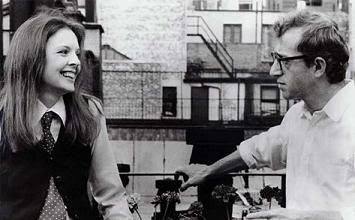
Annie Hall*


The 1970s were revolutionary in that people began to question once-acceptable institutions and lifestyles. One very radical change that transpired in the United States was the feminist movement. Along with this movement came the sexual revolution where suddenly women acquired more dominance in their romantic and sexual relationships. Women’s newfound independence offered them much more happiness and liberation, yet it seemed the rewards of this revolution were not mutual. Men became very threatened by the idea of women in control and were reluctant to embrace the idea. With men still clinging to the idea that their role was one of sexual master and family breadwinner, women struggled to find the equality they deserved when relating to men. Romance failed to live up to the fairy tale, and dating became an arduous struggle to build a successful, reciprocal relationship. Woody Allen seemed to have understood these struggles when he wrote and directed Annie Hall in 1977.

The film dissects the relationship between Allen’s neurotic Alvy Singer and his girlfriend of the film’s title played by Diane Keaton. The film provides a recapitulation of their romance from Alvy’s fatalistic perspective as he attempts to grasp some kind of justification for the relationship’s failure. In my paper, I will argue that Annie Hall interprets the tragic dimensions of 1970s romance by arguing that changing gender roles caused alienation and frustration within male-female relationships.

The New Female Role: Hurdles and Opportunities

For many women prior to the ‘70s, marriage seemed like a necessity and it was difficult to find security without finding a husband as well. Although it was becoming possible for women to remain single while maintaining happiness and success, choosing single life and the dating scene over the protection of marriage wasn’t as accommodating and liberating as it appeared to be. Explains Barbara Ehrenreich and Deirdre English in their book For Their Own Good: 150 Years of the Expert’s Advice to Women, “The constituency for neo-romanticism is the vast number of women who see themselves as potential "losers" in the sexual free marketplace: housewives who have no alternative means of support to their husbands' income and they fear, no alternative to their present husbands” (319). Besides rejecting the security of marriage, women adopting the single lifestyle encountered the likelihood of being objectified by men reluctant to recognize women as their equals. Says Margaret Adams, author of Single Blessedness: Observations on the Single Status in Married Society, about the role constrictions placed on single women, “Their age and physical attractiveness are repeatedly evaluated as more important than their personality or intelligence. They should be flirtatious and dressed to kill, yet not seem too ‘easy’” (211). In Annie Hall, Alvy immediately places these restrictions on Annie. Upon their first meeting, Alvy and Annie engage in an uneasy and somewhat awkward conversation in Annie’s apartment. Due to Woody Allen’s clever narrative style, the scene allows the audience to literally read each person’s thoughts from the subtitles inserted into the scene. Annie strives to impress Alvy with her interest in photography in order to convince him she is not some dim-witted bimbo, yet all the while the subtitles reveal Alvy pondering how great-looking Annie is, speculating how she looks naked. Allen emphasizes how because certain men possessed these superficial expectations, women struggled to establish a truly “liberated” role in their relationships with men. Although this was one of many impediments single women encountered, being recognized as bright and competent rather than visually stimulating was a crucial step for women striving to attain the respect of their male counterparts.

Annie’s initial problem upon meeting Alvy resides in her naiveté, trusting that Alvy will provide her with a secure relationship because he appears to be very intellectual and sophisticated. Says Ferm McKay, a university professor married for ten years, “Before feminism, our generation of smart girls used our intelligence to make the best deal in marriage. We matched ourselves with strong, confident men who could give us some of their identity. Now that we’ve found our own identity and our own emotional reality, we’re stuck with the cold, overbearing guy who was once such a good catch” (85). This is precisely what Annie comes to realize as her singing career takes off. She meets new and exciting people and develops a confidence completely independent of Alvy’s influence. Suddenly it becomes clear to Annie that Alvy’s intelligence and sophistication to which she once clung are, in fact, disguises for his obsession, jealousy and self-loathing. The romantic element of their relationship is no longer feasible, and Annie must move on. Jean Jamm, a 26-year-old trial lawyer, must have understood this situation when she said, “The very idea of a romantic life is ridiculous to me. I am looking for companionship and for activities that enrich my life” (Newsweek 67). Women were finally realizing the potential they held as individuals; meanwhile, men began to lose touch with their role in this new world of women.

Men Struggle with the Independent Woman

While women in the 1970s obtained freedoms in the workplace and in their relationships, men gained insecurities about where they stood in such a society. Explains Edward J. Bardon, psychiatrist affiliated with the University of Minnesota, “We commonly associate sexual prowess with the strong, dominant male and sexual responsiveness with the passive yielding female. To depart from our traditional role is to invite fears of our sexual abilities and attractiveness” (31). While men found the independent woman attractive, as soon as he had her in his life, this independence became more threatening to him. Judy Jarvis illustrates this point very clearly in her article, “The New Rules in the Mating Game” from a 1978 issue of Esquire Magazine. She suggests that the man will claim, “‘I like you because you’re strong and independent. So strong.’ But as soon as the woman has other plans or runs into some other man when she’s out with him, he gets nervous. Then he’s on the telephone the next day trying to line her up for the next seven weekends. The independence is what grabs him, but he really wants her to be more dependent, more submissive” (40). As their relationship progresses, Annie begins to progress as well, proving her strength and independence to Alvy. Annie’s singing and talent improve and consequently her self-confidence and integrity increase as well. Her doubts about her own intelligence are diminishing and she no longer needs Alvy to reassure her of her self-worth. Annie’s newfound self-respect proves to be disastrous for Alvy, however, as he grows more insecure and possessive of Annie’s carefree, adventuresome life. He is reluctant to attend parties associated with the record producers and musicians Annie has befriended, and he complains incessantly during his trip California, while Annie is delighted with the cleanliness and excitement that Los Angeles has to offer.

Annie: It's so clean out here!
Alvy: That's because they don't throw their garbage away, they turn it into television shows.


Not every man in the 1970s felt this same insecurity, and by simply portraying this one characteristic of the male perspective, Allen is clearly stressing that which challenged women’s liberation as to offer a unique interpretation of widely discussed issue He presents Alvy and Annie as developing distinct viewpoints due to Annie’s newfound independence. While Alvy is aware of this reality, however, he neglects the opportunities to inform Annie of his concerns, leaving the pair with a whole new conflict that affected similar romantic relationships during the 1970s.

Breaking the Silence

An obvious obstacle in Alvy and Annie’s relationship is their failure to communicate problems and maturely search for a solution. Annie, though it may have been easier for her as a woman to express emotion, finds difficulty in being honest with Alvy as he habitually turns serious issues into comical banter. As Tim Dirk explains in his review of Annie Hall, “Annie stutters about her love for [Alvy]. Serious emotional words fail Alvy when he tries to tell Annie how much she means to him. He circumvents the word and retreats into comedy to directly avoid vowing that he loves her.” A part of this dilemma lies in the freedom given to women that, although guaranteed power, placed an equal burden of possibly voicing anxieties that would send their men packing. Carol Tavris and T. George Harris, both psychologists, point out that, “So many women find themselves stranded on the line between liberation and loneliness, facing impossible alternatives. The choices are tough. Stay with an unsatisfactory status quo, compromise, press for change, or leave. Or opt for celibacy” (49). In his inability to take Annie seriously and behave seriously himself, Alvy alienates Annie, triggering her uncertainty as to what she can discuss that will not divert him.

Issues about Alvy and Annie’s sexuality are also confined and though they argue about it, neither feels the need to discuss it except to their respective analysts. Tavris and Harris explain, “With all the chatter about sex today, people are still reporting that they have severe trouble telling each other what they really want—in sex and in love. It’s easier to talk to an anonymous questionnaire or a professional listener than to the stranger in our bed” (49). Still, undeniable differences existed between men and women especially in how each regarded sexual issues, and had these differences been voiced between Alvy and Annie, the conflict may have been alleviated somewhat. As James C. Neely, journalist for Esquire magazine, explains in his article, “Male and Female: Nature’s Cosmic Joke,” the problem is that, “Young women and men come together for wholly different psychological and social needs, deriving perhaps from infantile sexual conditioning, but they are not the least concerned with such at the time of the required coupling” (42). We see, for example, how Annie and Alvy view their sex life differently as both simultaneously discuss the issue with their personal psychiatrists:

Alvy's analyst: How often do you sleep together?
Annie's analyst: Do you have sex often?
Alvy (lamenting): Hardly ever, maybe three times a week.
Annie (complaining): Constantly, I'd say three times a week


Alvy’s constant need for sex and the problems it causes for Annie are illustrated in Neely’s explanation: “The young man feels his sex as a specific discomfort, a localized tension and drive, with uncontrollability at the damndest times. It gets in his way. He wants her specifically for release, and he painfully learns discipline in risking himself in this often-frustrating way. The young woman wants his sex for another reason entirely” (42). Allen’s depiction of sexual estrangement between Alvy and Annie accentuates the fact that men and women maintained very distinct sexual views and this led to further frustration. Sex definitely presented a discord between men and women; the bigger problem, however, arose when men began to lose control of their dominant sexual role.

The Sexual Revolution and the Death of the Dominant Male

Generally speaking, men have viewed themselves as the pursuers, the dominators and the conquerors in their relations with women. To maintain confidence and comfort, men required women to be passive and adhere to their demands. “To the man steeped in the tradition of dominance, authority and power, women’s liberation appears as a distinct threat. As women become independent and achieve positions of greater control, these men sense mastery slipping from their grasp. They view this as an uncalled for usurpation of power.” (Bardon 216) Where this revolutionary concept appeared to cause the most affliction among men was within their sexual relationships. “Women’s liberation places increased pressure on the male to perform sexually and be a good lover. The feminist message that women have an inherent right to sexual satisfaction means that the male can no longer be concerned only with his own pleasure. He must now make efforts to please his partner” (Bardon 221). Alvy displays definite anxiety when faced with Annie’s constant need to smoke marijuana before they have sex. Annie claims she needs to feel relaxed, but Alvy exhibits concern over whether or not he gives her enough pleasure to enjoy the experience “free of grass.” He is also struggling to maintain dominance, as he feels threatened by his inability to control Annie to the fullest extent. The marijuana is essentially what pleases Annie rather than Alvy’s skills as a lover. Had Alvy felt confident in his sexual abilities, he would not have persistently objected to Annie’s desire for the drug. Nevertheless, Annie agrees to sex without marijuana, and although they go through the motions of sexual intercourse, Annie’s apathetic and removed spirit rises from her to sit in a chair next to the bed while Alvy is left with only her body. Alvy’s inadequacy issues intensify when Annie then says, “Alvy, do you remember where I put my drawing pad? Because while you two are doing that, I think I'm going to do some drawing.” As film critic Tim Dirks points out, “He is frustrated, because he cannot entirely possess her.”

The simple fact that Annie engages in drug use prior to sex was also something very groundbreaking about women’s sexuality. Females took an active role in pursuing a more beneficial sex life, and a man had to accede to not always having the ability to please a woman on his own. According to a poll of 100,000 readers in Redbook magazine taken in 1975, nearly 65 percent of the women occasionally had sex while under the influence of alcohol and 63 percent of the women under 25 sometimes smoked marijuana before having sex. Annie Hall represented a whole generation of women discarding the expectations of men because it was finally time to acquire some of the power. “Our findings show that women have completely abandoned the role of passive sexual partner. They are now active participants in the sexual relationship,” states sociologist Robert J. Levin. (Newsweek 57) Allen’s insecurity concerning male dominance likewise manifested itself in Alvy’s doubts about Annie’s faithfulness.

The taboo concept of the promiscuous female simply did not seem possible to men prior to the sexual revolution. The idea of a woman straying from her obligation and loyalty to one man seemed absurd even though when men would occasionally cheat or desire another woman, women still practiced fidelity in order to please her partner and keep him in her life. These double standards are illustrated in an article by Karlyn Bowman featured on the website, The Public Perspective: A Roper Center Review of Public Opinion and Polling. It states, “There is a long-standing belief that men are more prone to temptation than women. In 1943, in one of the first questions of its kind, Elmo Roper didn't even think to ask men about women's extramarital dalliances…In 1946, when Gallup asked women to list the top faults of their husbands, thoughtlessness topped the list followed by bossiness and ‘other women.’ ‘Other men’ wasn't even mentioned by men who were asked about their wives' faults.”

The ‘70s ushered in a change, however, that would contribute to the sexual liberation of women as well as the additional concern of men. In the same sexual survey conducted by Redbook magazine mentioned above, one-third of the 100,000 women polled claimed to have had extramarital affairs, while 36 percent said they would like to participate in one. Because it was becoming acceptable for women to abandon their monogamous duties, men no longer held the upper hand and this loss of control alarmed them. Allen exhibits his apprehension through Alvy’s resentment. In the midst of their relationship, Alvy grows increasingly jealous of Annie and her relationships with other men, including her professor of a class he convinced Annie to take. As Annie discusses her professor’s fondness for her, Alvy’s concerns escalate, and he accuses Annie of having an affair and proceeds to spy on her when she goes to class. Alvy’s hypocritical nature surfaces when Annie points out that Alvy is the one who wanted to avoid the commitment and keep things “flexible.”

Without a doubt, the ‘70s included a wholly separate breed of men who were comfortable with women taking control of their relationships. Nevertheless, Allen chose to focus on the idea of threatened masculinity to draw attention to some the setbacks of the feminist movement. With Alvy and Annie’s growing frustration and anxiety came their urge for change. The pair realized what they disliked in the other person, and suddenly a simple irritation with the relationship resulted in a ruthless struggle for power.

Finding Equality and Mutual Respect

A difficult issue most couples faced when dating was the struggle to change his or her partner in an effort to gain power in the relationship. One person is not satisfied with the other’s behavior but the attempt to change the other’s life could lead to serious ill effects. For example, Letty Cottin Pogrebin, co-founder of Ms. Magazine and the National Women's Political Caucus, makes a valid point when she says, “There may be moments when you wish you had never begun. Guilt, ambivalence and fear of abandonment are common by-products of the struggle for change” (44). Allen was aware that a slight hesitance was still present in women despite their urge for liberation, and he took that concept and manipulated it as to challenge the idea of feminism as successful. Alvy and Annie are constantly debating about Annie’s intelligence. Alvy pressures Annie to take adult education classes further reinforcing Annie’s uncertainty about her intellect. Alvy will deny thinking Annie is inferior, but he finds comfort in trying to transform Annie into someone more like him. As film historian Patricia Mellencamp points out in her book A Fine Romance: Five Ages of Film Feminism, “The real key to Allen is his ambivalence toward women—pure Freud, with women loved and feared, worshiped and disdained. Annie refers to herself throughout the film as stupid. Alvy/Allen denies it while the film illustrates it” (95). Allen observed the change in the female role during the 1970s, and rather than embrace its potential for women by portraying Alvy as someone who supports and encourages Annie, he instead represents Alvy as egocentric and manipulative suggesting Allen’s reluctance to bestow upon women their sought out place in society.

In his dismissal of Annie’s individualism, Alvy does not see her interests or opinions as valid or significant and consequently, he attempts to transform her personality into a reflection of his own. Fixated on the subject of mortality, Alvy wants to buy two less-than-uplifting books for Annie including Ernest Becker's The Denial of Death and Jacques Choron's Death and Western Thought. Basically his ulterior motive is to convert Annie into a death-obsessed, intellectual New York Jew. On the contrary, Annie is considering buying something more simple and innocuous like The Cat Book because she is thinking of buying a cat to alleviate the loneliness of her social life. Her outlook appears trivial to Alvy, and through Alvy’s rejection of Annie as her own person, Allen’s skepticism of female independence is revealed despite any instances in the film where Allen may show Annie in a positive light.

The Romantic Comedy, Or Something Like It

Woody Allen significantly revolutionized the romantic comedy genre with Annie Hall, as it was the first of its kind to convey the neuroses men and women share when struggling to find equality in their relationships. In reality, romance is not always beautiful, elating and painless where two lovers engage in passionate embraces to the tune of violins. Relationships are unstable, bewildering, and disconcerting, and Allen took the initiative to portray relationships in this manner to offer his audience a new way of approaching film romance. Allen does not sugar coat anything about love for entertainment value but creates a character in Alvy Singer that helps provide an interpretation of the fears and trepidations of a selection of single men in the 1970s.

Allen’s film also comes at a time when the male sex symbol of classic romantic cinema was surely fading. For example, in Jeanine Basinger’s article, “A Farewell to the Male Mystique,” the role of the female is discussed as empowered and no longer in need of her male counterpart to achieve happiness. Says Basinger, a film professor at Wesleyan University, “The ‘road’ pictures of the late sixties, which featured runaway wives and women out in the world seeking themselves, marked the time when women began to provide their own escapes. No longer did a young woman stand at her bedroom window, dreaming of a man to come and take her away. If she wanted to go, she went” (23). Gregg Kilday, journalist for Daily Variety, also points out that, “It's the women --- whether empowered by family money in the old days or by their own high-powered careers in more recent films --- that usually have the upper hand in the battles of the sexes that ensue” (26). With women not only taking control of their lives but also the texts of films in the late ‘60s and ‘70s, Allen made a bold statement with Annie Hall by presenting the film from his character’s perspective. Although we see Annie as liberated through her separation with Alvy, this liberation is interpreted as a loss for Alvy and it is he, the male figure of the film, who obtains our sympathy. Women may have gained a certain degree of independence in the 1970s, but with Annie Hall, Woody Allen offered the interpretation that changing gender roles could also result in social, intellectual, and sexual barriers between men and women that would inevitably limit this newly acquired independence.

Bibliography available upon request

*1977 Academy Award Winner for Best Actress (Diane Keaton), Best Picture, Best Director, Best Original Screenplay

Wednesday, November 02, 2005

Talk to Her (Hable con ella)*


When people watch films, they may take for granted that the experience they are having is a direct result of the way the film’s story is being told. Because film is a narrative medium, there is always some kind of narrator pulling the strings. Whether it’s a character in the film, the screenwriter, or the director, someone is always manipulating the audience. That manipulation is the plot, or the particular arrangement of the film’s main story events. Some people assume that plot and story are the same thing but think about a film like The Usual Suspects or Pulp Fiction. These films have a non-linear narrative structure and thus the plot is much different than the story. If we saw whole “story” of The Usual Suspects play out chronologically, there would be no suspense or surprise, which is why the film’s “plot” rearranges story events out of order. A spectator can have a completely different and altogether more satisfying experience with a film simply because its story events are organized in an unconventional manner. The film I am going to focus on that brilliantly illustrates this cinematic principle is Pedro Almodóvar’s Talk to Her. With careful examination of how plot manipulates story, it becomes possible to understand why exactly this film has the effect that it does.

Talk to Her is a film about four individuals whose lives intertwine through a sequence of events that span a period of about five years. What is interesting about Talk to Her is that its story is quite simple, yet the film itself is narrated in a very complex way. The basic drama consists of a series of conversations between characters struggling with their own personal hopes, fears, and desires. Although the film is constructed in a complex way, it is not done so haphazardly. By examining the way in which this story is told, it becomes clear that every liberty the plot takes regarding the story functions to manipulate the spectator’s level of knowledge throughout the film. This manipulation occurs in several ways. By rearranging story events, the plot forces the spectator to reevaluate his or her knowledge about certain characters and events. Repetition of story events is employed as a way of refreshing the spectator’s knowledge enabling him or her to realize the narrative significance of those events in relation to others. The plot also manipulates the spectator’s knowledge by omitting or skipping important story events via the ellipsis. Finally, manipulating the story can serve as a means of generating specific feelings in the spectator toward characters as a means of achieving the film’s main objective.

Story Order vs. Plot Order

A plot can take many liberties when rendering the events of the story most often as a means of creating narrational gaps. In Talk to Her, narrational gaps result from the way the plot tells Benigno’s story and the way it tells Marco’s story. Levels of knowledge regarding story events change as the spectator is given different amounts of narrative information about each character. Marco’s entire relationship with Lydia and its history unfold chronologically allowing the spectator to experience events in Marco’s life as he experiences them. With Benigno it is just the opposite. The spectator is very unclear about he and Alicia’s history since the plot does not provide this information until later in the film.

With Benigno and Alicia, we move from the present to the past in order to comprehend the nature of their relationship. In Scene 2, we see pictures of Alicia in Benigno’s apartment which suggests that they are close, yet it is unclear how Benigno came to be Alicia’s caretaker, what caused Alicia’s coma, and why Benigno has such strong feelings for her. These questions go unanswered throughout Acts III and V, but Benigno’s affection toward Alicia suggests that their relationship extends beyond that of patient and nurse. With Marco and Lydia it is just the opposite. Their meeting, relationship, and Lydia’s accident are played out chronologically from the beginning with the exception of Act VIII which recalls the events of and leading up to the encounter that takes place between Marco and Lydia in Scene 16.

Act V becomes a very important one in the film because it marks a shift in the spectator’s knowledge. Up until this point, the spectator knows much more about Marco’s life than Benigno’s life, specifically in regards to Lydia and Alicia. Yet prior to Act V, there was no narrative motivation for Benigno to recall his history with Alicia. The only other people with whom he interacted were already aware of Alicia’s condition and her relationship to Benigno. Bordwell explains, “The flashback is usually motivated psychologically, as character recollection. The narration motivates the presentation of the flashback realistically, letting us eavesdrop of the character’s memory.” In Scene 26, Marco and Benigno meet in the hospital, a friendship quickly grows between them, and it is Benigno’s trust in Marco that causes him to disclose the details of his past regarding Alicia. This disclosure occurs through a flashback that finally reveals the history between Benigno and Alicia. The spectator is now aware of the fact that Benigno and Alicia are practically strangers and with this new knowledge, the spectator can more accurately judge Benigno’s character. Benigno’s tenderness and affection toward Alicia from this point on are subject to scrutiny due to the nature of his feelings for her.

Acts I-IV go back and forth between Marco’s story line and Benigno’s story line and in Act V we see the merging of these two lines. Although the two characters are dealing with a similar set of circumstances when they meet, the spectator’s knowledge regarding the two characters is very different. Marco’s emotional state is accounted for because he and Lydia’s story has already been told. Through Benigno’s flashback, his character is fleshed out more and this enables the spectator is judge Benigno’s character more accurately.

Narration and Repetition

When Bordwell discusses the function of shuffling story order, he points out that doing so forces the viewer to evaluate material in the light of new information about prior events. An example of this in Talk to Her involves the scene in the car between Marco and Lydia on the day of Lydia’s accident. The first time, in Scene 16, we don’t see the entire conversation or anything that has led up to it. Lydia appears distraught and tells Marco that they have to talk after the fight and it is uncertain what is on her mind.

The encounter is repeated in Scene 50 through flashback, but this time the entire conversation is played out. Lydia and Marco have just attended the wedding of Marco’s ex-girlfriend, Angela. In the car, Marco discusses his feelings regarding Angela and this prompts Lydia to tell Marco that they have to talk after her fight. We then return to the present to a scene between Nino and Marco in which Nino explains to Marco that he and Lydia had rekindled their romance a month prior to the fight and she was going to tell Marco after the fight. Having just seen the exchange between Marco and Lydia in the car, the spectator is now able to use Nino’s revelations to clarify Lydia’s feelings of apprehension. The reiteration of the scene is important because without it, the spectator would not see the significance of one scene’s relationship to another. Lydia’s anguish in Scene 16 is essential but without repetition might likely be forgotten. By bringing it up again in Scene 50, and following it with Nino’s disclosure to Marco, the spectator is able to link Marco’s pain to Lydia’s pain and this makes their break from one another all the more devastating.

The Function of Ellipses

In addition to rearrangement and repetition, the plot can also manipulate the story by way of an ellipsis. David Bordwell writes in Narration and the Fiction Film, “If an omitted span contains significant information, the ellipsis can create a suppressive narration that shapes our hypothesis-forming activity.” This is true of the ellipsis that occurs from Scene 59 to Scene 60. In Scene 59, Benigno is accused of raping and impregnating Alicia. The scene creates a very strong curiosity in the spectator about what will happen to Benigno and Alicia as a result of this incident. The plot moves forward eight months in time from Scene 59 to Scene 60, and the spectator is left with several questions. Did Benigno go to prison for the rape? Did Alicia have the child? Did Alicia ever wake from her coma? Marco has been away for these eight months so he cannot answer the questions. However, in Scene 61, when Marco discovers that Benigno is in prison, his curiosity provides the motivation for having these questioned answered throughout the rest of the film. Because Benigno was imprisoned and forbidden to see Alicia or speak with anyone at the hospital, Benigno is in a similar position as Marco and the spectator. He does not know what happened to Alicia anymore than we do. Since Benigno was the spectator’s link to Alicia, expectations regarding her fate are intensified. Marco’s discovery of Alicia in the dance studio in Scene 69 is one of the most shocking and dramatic moments of the film, and this is because of the way the plot is constructed. Because the narration has been restricted to Benigno and Marco, and Benigno and Marco were absent from Alicia’s life in those eight months, there was no narrative motivation for presenting those eight months of her life in the plot. Consequently, that information was withheld from the plot until something motivated its revelation. The ellipsis in Talk to Her is not an arbitrary liberty taken by the plot. It serves to create a curiosity in the spectator about a key piece of narrative information so that when the information is finally revealed, the spectator will appreciate its significance.

How Structure Manipulates Emotion

Though a lot can be said about how plot manipulates spectator knowledge, there is also much to be said about how it manipulates the spectator’s emotions. Story events are arranged in the plot of Talk to Her in such a way that the film generates very specific feelings about each character. In Acts I-IV, the spectator is introduced to both Benigno and Marco. While nothing occurs in Benigno’s scenes (Acts I, III) that would cause the spectator to feel strong emotions toward him, in Marco’s scenes (Acts II, IV) the spectator is able to see his relationship with Lydia as well as Lydia’s accident. Before Act V begins, the spectator has been given much more reason to be sympathetic toward Marco since the emotional ups and downs of his relationship with Lydia have been played out.

When Benigno finally does reveal his history with Alicia in Acts V-VI, it becomes apparent that Benigno is actually obsessed with Alicia. This creates uneasiness in the spectator toward Benigno. From this point on, it becomes difficult to empathize with Benigno’s loneliness in the same way we would Marco’s because we know now that no relationship ever existed between Alicia and Benigno. Moreover, Alicia’s accident is not enacted in the film’s plot and Lydia’s is. Because the spectator is given a visual of the tragic event that put Lydia in a coma and is not given the same for Alicia, the spectator is able to feel even more sympathy for Marco’s character.

In Act VII, an event takes place that strengthens the spectator’s anxiety toward Benigno. In Scene 45, while massaging her, Benigno tells Alicia about a silent film he has just seen. The scene is intercut with a sequence from the silent film and there is overt sexuality present in the silent film sequence that is echoed in the way Benigno is touching Alicia. The scene is upsetting because it reveals the raw desperation and loneliness Benigno suffers from. It suggests an instability in Benigno that appears to be a threat to Alicia and consequently comes off as threatening to the spectator.

In Act VIII, there is a flashback, or more accurately a recount of the conversation between Lydia and Marco on the day of her fight. Lydia’s feelings of anguish were unclear the first time the scene was played out but are clarified in Act IX-Scene 52 when Nino tells Marco about Nino and Lydia’s relationship. Act IX becomes another point in the film where the spectator is prompted to feel compassion for Marco because Nino has explained to Marco how Lydia was truly feeling. The real tragedy, however, lies in the fact that we now know why Lydia was so reluctant to talk to Marco in the car. Marco had just told Lydia that his relationship with Angela was over, and Lydia’s guilt kept her from telling Marco that her relationship with him was, in fact, over as well. After Nino’s revelation in Scene 52, it is as though Marco has lost Lydia all over again and this makes him that much more sympathetic to the audience. While the spectator’s feelings of sympathy toward Marco are intensified in Act VIII, those feelings of uneasiness toward Benigno are simultaneously intensified. In Scenes 53-59, the fact that Benigno has raped and impregnated Alicia slowly comes to light. The nurses discover that Alicia has been missing her periods and Benigno was covering this up. Meanwhile, Benigno confesses to Marco that he wishes to marry to Alicia, which is very off-putting to Marco. The events surrounding Benigno in Act IX are even more suggestive of his instability than those of Act VII.

In Act X, Benigno undergoes a complete mental breakdown and eventually commits suicide because he realizes that his desire for Alicia will never be fulfilled. While everyone else in the film has dismissed Benigno, Marco remains his friend even until Benigno’s last moments of life. He is even willing to disobey Mr. Sanz’s requests to keep the news about Alicia from Benigno in order to prevent Benigno from killing himself. In Act X-Scene 78, Marco visits Benigno’s gravestone and it is in this scene that our compassion for Marco is at its peak. It is clear that despite Benigno’s unforgiving behavior, Marco still cared for him and is upset that Benigno’s unfulfilled desires drove him to commit an act of such desperate proportions.

The conclusion in Act XI thus functions as the film’s catharsis because it represents a resolving of the internal conflicts suffered by both Benigno and Marco. The spectator’s ability to see Alicia alive and well is rewarding because Benigno was never able to do so. In addition, the exchange between Alicia and Marco at the theatre is also rewarding because it suggests that Marco’s feelings of loss might be alleviated through a potential relationship with Alicia. In order to make the union of Alicia and Marco emotionally gratifying, the plot had to manipulate the story in a very specific way. Everyone loves a happy ending in which two people find one another and fall in love, however, a happy ending can often appear too predictable and thus too implausible for the audience to truly feel affected by it. With Talk to Her, the story has been told in such a way as to generate the kind of concern and expectation necessary to make the ending exactly what the audience wanted to see, and this speaks volumes about Pedro Almodóvar’s skills as both a filmmaker and a storyteller.

Talk to Her is an important film because it provides the spectator with an opportunity to better understand his or her own viewing tendencies. It suggests that when a film has an unconventional element, it is in the audience’s best interest to pay attention. The unconventional element in Talk to Her is clearly its narrative structure. By paying closer attention to the narrative structure and what Pedro Almodóvar is attempting to accomplish with it, we as an audience can better understand our own relationship to the film. While it is possible to enjoy Talk to Her without picking apart and examining its entire plot construction, what you can take away from an analysis like this one is a stronger appreciation for cinema and its incomparable ability to manipulate human perception and emotion.

*2003 Academy Award Winner for Best Original Screenplay

Wednesday, October 26, 2005

The Brown Bunny


My first exposure to Vincent Gallo was a viewing of Buffalo '66 in my American Independent Cinema class senior year of college. I’m not sure exactly why it had taken me so long to see that film since I heard quite a bit about it. Yet there are only so many films a person can view and thus, Buffalo '66 stayed off my radar for a number of years. When I finally did see it, I was mesmerized. Many might disagree with me here but I think Vincent Gallo has a phenomenal charm about him. In some senses he could be considered a narcissistic filmmaker and the characters he plays are not always sympathetic or accessible. However, he’s very unique in physical appearance and the way he captures the world he inhabits both as a filmmaker and as a character is beautiful in its innocence, candor and simplicity.

At the same time my class was studying Gallo and his first film, Gallo’s sophomore film, The Brown Bunny, was garnering a great deal of exposure and criticism due to the now infamous sex scene between Gallo and Chloë Sevigny's characters at the end of the film. When it was first screened at Cannes, The Brown Bunny did not go over well with audiences. According to Gallo, he was pushed to show the unfinished (or rather uncut) version of The Brown Bunny against his better judgment. It is not surprising then that the film was not received well. Besides the sexual explicitness, viewers were bored to tears due to painfully lengthy sequences of almost no dramatic significance. These sequences would eventually be edited for the American release, although some might argue that even the edited version of this film is just one large painfully lengthy sequence of almost no dramatic significance.

I was not deterred by the criticism, however, and as luck would have it, my American Independent Cinema professor wasn’t either. I recall a conversation I had with him in which he told me, “I just want to see this movie because everyone else seems to hate it.” While that wasn’t necessarily my reasoning for wanting to screen the film myself, I did wonder what certain people’s aversion toward The Brown Bunny was all about. Did the sex scene ruin the entire viewing experience? Was the film so boring audiences simply could not find anything else redeeming about it?

As my taste in cinema has become more refined, I often find it necessary to go against the grain when I encounter a film the majority of people dislike. It becomes my own personal goal to find an element of that film that everyone else missed because I want to be one of the few who saw something unique.

So instead of taking a pass on The Brown Bunny because of what I had heard about it, I rented the film as soon as I could. When I first watched the edited version of The Brown Bunny at a very tolerable 93 minutes, it did feel like the film played a lot longer than that because the dialogue is extremely sparse and honestly, nothing really happens through much of the film. I can understand why audiences at Cannes were so angry and hostile being that the version they saw was just under two hours. While most of The Brown Bunny could really be cut if we were measuring the dramatic value of each scene, Gallo was able to recognize where he went overboard with the more monotonous sequences in the first version of the film. The opening scene of the motorbike racing, which was edited down a great deal, still feels lengthy but just lengthy enough to get the point without wanting to skip to the next scene or turn the film off entirely. Maybe some people would have given up on Gallo after that scene, but the strange repetitious beauty of it reeled me into the story. I also feel as though the scene takes on new meaning once the whole film unravels itself. But those are musings for a whole other analysis.

Watching The Brown Bunny was like being in a sort of dream state for an hour and a half. I felt myself floating along with the character of Bud Clay as he traveled across the country in his beat up old van. For anyone who’s ever taken a road trip, there’s a kind of hypnotic mysticism that occurs when you just sit back and absorb everything around you. The road seems to stretch out infinitely and while you are going somewhere, you could just as easily be going nowhere. You escape reality and are left with nothing but the open road and your own thoughts. For the viewer, the shots of Bud driving along lost highways and desolate terrain are peaceful, almost comforting. Yet for Bud, the open road is nothing but false hope. Bud is clearly plagued by a relationship he once shared with a woman named Daisy. Because we know they lived together in California and Bud is traveling to California, one can assume he is going back to find her. Something in their relationship must have gone awry because when Bud is alone with his own thoughts, he becomes distraught. He drives and drives in an attempt to fool himself that this journey will bring him back to a life he once had. However, the road mocks Bud. It is an illusion constructed in Bud's mind to help him avoid the pain and regret. He attempts to make emotional and physical connections with women along the way, yet these connections never last and he can only keep up the illusion for so long. The close-up images of Bud, lonely and haunted, are reminders that no matter how far he may drive, the past is never too far behind.

What I love about Vincent Gallo’s performance is how raw and unfiltered it is. While he may enjoy filming himself in states of melancholy and resentment, and for some people this is off-putting because it suggests a kind of pretension on his part, I am able to separate the director from the actor. I personally love to watch Vincent Gallo in states of melancholy and resentment because I consider them to be beautifully filmed and beautifully performed. Gallo has pure talent and he recognizes it. This is not such a bad thing. He is confident in his abilities as an artist, and that confidence comes out on the screen in the form of beguiling cinema.

Now, if you have heard of The Brown Bunny at all, you have most likely heard about it in conjunction with “the scene” in the hotel room. I’m not going to divulge any information about that scene in this review, however, because it is such a small aspect of the film in my opinion. I will say that it does stand out, not so much for its explicit sexuality, but more so because the scene is quite visceral while the film up until this point feels much more delicate and composed. The interaction between Bud and Daisy is messy and frustrating and while there is good reason for this, it is a difficult scene to watch when comparing it to the rest of the film which, for me, plays out like a bitter yet consoling Chopin nocturne. I think the scene has its place within the greater context of the film but it certainly should not be used as criteria for judging The Brown Bunny in its entirety. I will say that whether Gallo intended it or not, his decision to create this scene and consequently get everyone in the film community intrigued and disgusted was a brilliant marketing ploy. If this scene is the reason people see the film, then I am that much happier it was included in the final cut.

The viewing experience I had with The Brown Bunny was not unlike the one I had with Lost in Translation, another film that seemed to go over the heads of many people. Although much of the film is simply watching a character float through time and space, it is liberating to not see that character bound by narrative convention. Dialogue is rarely exchanged making what the characters do say to one another all the more acute and effective. It is minimal cinema, and it certainly takes some getting used to if you are only accustomed to the kind of filmmaking that puts audience expectations before artistic merit. What you can find in a film like The Brown Bunny or Lost in Translation is the filmmaker’s spirit, untainted and sincere. While there are a variety of films that could only be successfully executed with the contribution of thousands of crewmembers, there are films that succeed because they remain under the control and design of one individual. No external forces manipulated that filmmaker’s intentions for the film and therefore the end product becomes a true echo of the artist. To me, getting to witness that echo is a rare privilege.

I don’t begrudge anyone who disliked The Brown Bunny or finds Vincent Gallo to be a pompous, self-involved film snob. However, part of me does wish that people could recognize the power of art in its purest form. The Brown Bunny is not a series of Hollywood clichés strung together for the sole purpose of entertainment or profit. Gallo’s film is honest with its audience without fear of insulting it and consequently stands apart as one of the few cinematic breaths of fresh air.

Monday, October 24, 2005

Down By Law


Most classical Hollywood films take the approach that unless a scene contributes to the basic narrative of the film, whether through its dialogue or action, the scene is not worthy of cinematic attention. In other words, there is no room for anything that might be considered mundane or irrelevant to the audience. Therefore, if one were to sit down and watch a Jim Jarmusch film, it would immediately become evident that the world Jarmusch wants his audience to see steers from the path Hollywood has been paving for the past century.

Initially interested in writing, Jarmusch studied literature in New York and Paris. Jarmusch was exposed to world cinema while in Paris and when he returned to New York applied and was accepted to the graduate film program at NYU despite only submitting a writing sample. The school awarded Jarmusch the Louis B. Mayer fellowship but mistakenly sent Jarmusch the money instead of sending the school his tuition. Capitalizing on the school’s error, Jarmusch took the money and used it to finance his thesis film, Permanent Vacation. Jarmusch went on to make a half-hour short called Stranger Than Paradise, which would become his breakthrough feature film. The film won the Camèra d’Or at the 1984 Cannes Film Festival and the unexpected success of the film established Jarmusch as a principal player in the world of American independent cinema. Jarmusch followed up Stranger Than Paradise with another film that would explore the humdrum lives of individuals seemingly indifferent to the worlds they inhabit. More than his choice of subject matter, the film’s specific style created an auteur in Jarmusch and many of the stylistic choices of the film would become staple elements in Jarmusch’s subsequent films.

In Down By Law, Jim Jarmusch utilizes the long take and depth staging as well as very deliberate character placement within the frame, and it is in these careful cinematic choices that Jarmusch effectively illustrates the alienation and emotional discrepancies of his characters.

Jarmusch incorporates very little camera movement in Down By Law with the exception of several tracking shots interspersed throughout the film. The film opens with a variety of tracking shots of the bayou and streets of New Orleans. Robby Muller is responsible for the black and white cinematography, and the gritty murkiness Muller is able to capture in the film’s opening shots reflect the subdued and desolate tone of the rest of the film. In the prologue the audience is introduced to Zack, a sluggish DJ and Jack, a small-time pimp. The characters seemingly have nothing to do with one another, but what they do have in common is their personal attitudes and their relationships with women and this is established through the staging and framing of the first few scenes.

In Jack’s first scene he wakes up next to Bobbie, a black woman who we assume he has slept with only to walk outside and check on Julie, a white woman who has obviously spent the night there as well. She is seated in a rocking chair away from Jack and does not look at him as he speaks to her. He goes back inside and lies back down in the bed next to Bobbie. He faces her and wraps his arm around her while she, like Julie, faces the camera with her back toward Jack. She has a look of dismay on her face that strongly suggests detachment on her part.

After several more tracking shots the audience is introduced to Zack. He creeps into his apartment and looks off-screen. The next shot is framed at a low height so as to capture Laurette asleep on a mattress that is lying on the floor. The frame truncates Zack until he sits down onto the bed. The next shot frames Laurette from the side of the bed (the camera has moved 90 degrees) so she is now facing the camera and Zack is behind her. She looks toward the camera as Zack looks at her and just like the shot of Bobbie and Jack, there is a disconnection between Laurette and Zack. Through something as simple as camera placement and character placement, Jarmusch has immediately illustrated the social complexity of the film.

Following the opening titles of Down By Law, there are several more sequences involving Zack and Jack’s personal lives. The first sequences deal with their inability to communicate with the women in their lives. The first scene following the titles reveals Laurette in the process of throwing Zack’s things out the window of their apartment. The scene has four shots and each is framed in a way as to further illustrate the emotional distance between Laurette and Zack. The first shot frames Laurette in the foreground throwing Zack’s things while Zack sits apathetically in the background. Zack simply sits on the edge of the mattress and remains speechless as Laurette proceeds to destroy everything he owns. His presence in the scene is barely felt due to his inaction but it is further downplayed because Laurette is dwarfing him in the frame. The next shot frames Zack in the foreground as Laurette walks in and out of the frame until finally standing still, out of focus, in the background. She calms down and tries talking to Zack in a composed and understanding way, but he continuously turns his head and shifts his weight away from her. Eventually Laurette walks away from him and the scene cuts again. The camera has shifted about 180 degrees so that Laurette is facing the camera in the foreground and Zack is in the background with his back to her. Zack continues to be difficult with her until she snaps again and resumes the destruction and disposal of his things. It’s only when Laurette is about to throw one of Zack’s pairs of shoes out the window that Zack finally speaks up and tells her to stop. Both amusing and disheartening, the moment solidifies Zack’s complete selfishness and lack of concern for his relationship with Laurette.

This theme of alienation is further illustrated in the following scene between Jack and Bobbie. The scene is also cut into four shots and the camera repositions itself in the room similarly to the way it does in Zack and Laurette’s scene. The first shot frames Jack in the foreground at his desk counting money. Bobbie is in the background lying on the bed. She proceeds to talk about all of his flaws and Jack barely utters a syllable. He defends himself only by saying that he needs to have fun. Again there is the image of a character in the foreground with his back toward the person who is talking to him.

Jarmusch never inserts close-ups or even medium shots to heighten dramatic effect, and often the character that is commanding the scene is in the background and out of focus. What is important is the characters’ lack of command over one another and this is emphasized by the position of the characters within the frame. This tendency of characters to look away from one another and distance themselves from each other within the frame becomes a pattern that Jarmusch will utilize through repetition and variation throughout the remainder of the film.

There are several extreme long shots in Down By Law that, although brief, draw attention to themselves because of the way in which they are framed. Characters are often dwarfed by their surroundings and are positioned within the frame in a way that, if they hadn’t already been established as central characters in the film, would probably go unnoticed. An example of this kind of shot is when Zack approaches the liquor store. The shot is interesting not because of its shot scale but rather because Zack does not really appear to be the focus of the shot despite being the only human figure in the shot. The physical architecture of the buildings is what seems to dominate the frame as Zack is located in the far right background, and even in the following shot which cuts to a closer shot of Zack, the framing seems to favor the liquor store/bar. The top of the frame is positioned right above the doorway and window and because Zack is sitting on a trashcan at the bottom of the frame, there appears to be an inordinate amount of headroom in the frame. This is certainly unconventional framing but what it does for the scene is literally put Zack in his place. He is drunk, unemployed, alone, and his life lacks any real direction. In reality, Zack surely would not warrant attention or special treatment and Jarmusch respects and understands his character enough to realize that his camera should not behave any differently.

Once Zack and Jack are in prison together, Jarmusch again employs his earlier style of depth staging and character placement to establish the difficulty the two characters experience as they attempt to relate to one another. When Jack first arrives, he and Zack share a disagreeable moment when Zack attempts to trap Jack in between the bunks with his legs. Jack immediately pushes his way out and moves to the foreground of the frame. He is now on one side of the frame in the foreground while Zack is on the other side in the background and out of focus. The alienation and distance that was illustrated in earlier shots with similar framing becomes important here because immediately it is evident that the same kind of relationship exists between Jack and Zack. In a later scene, the same framing occurs again while Jack reveals to Zack a fantasy he has. Jack recites the monologue all while his back is turned to Zack. The exchange is unique because Jack is speaking about something important to him yet the person he is passing all of this onto is behind him in the background and out of focus. In other words, Jack isn’t really sharing anything with Zack.

The turning point of Down By Law both narratively and stylistically seems to come with the arrival of Bob. The framing changes significantly from this point on for the simple reason that there is now a third character. One of the most beautifully composed shots of the film occurs when Bob arrives and enters the cell. Jack and Zack are situated on opposite sides of the frame. They each have a black eye from a fight that occurred between them in the previous scene. On occasion they will look up at Bob but for the most part, Jack and Zack spend the scene slumped over and dejected. Bob speaks little English most of which consists of a variety of popular American catch phrases he attempts to use to describe his feelings. The humor of the situation is undeniable but ironically it has nothing to do with Bob’s inability to communicate properly. When the film finally introduces a character who is totally unconcerned with impressing the rest of the world, Jack and Zack’s constant desire to be cool, unattached, and aloof appears totally ridiculous by contrast especially as they sit at the edges of the frame beaten up and miserable.

In the scene when Bob attempts to get rid of his hiccups, he walks back and forth between Jack and Zack who are again at opposite sides of the frame. He suffers from an inability to get their names straight and it is here where the idea that Jack and Zack are interchangeable characters truly emerges. Their back-stories have given them individual identities, but strip all of that away and Jack and Zack are basically the same man. This makes it all the more amusing whenever they try to distance themselves from one another.

With each scene that passes, character placement becomes much less disjointed. When Bob and Zack share a scene, they face one another and when Bob and Jack share a scene they also face one another. One of the most important scenes in the film is the one in which the three men share their reasons for being in prison. The scene begins with Jack and Zack leaning against the gate of the cell looking outward. Bob is pacing in the background and as he is pacing, he looks at Jack and Zack almost as if he knows there is some unspoken rule about staying on opposite sides of the cell yet chooses to break the rule anyway. Rather than remain in the background, Bob positions himself in between Jack and Zack beside the gate. He also makes eye contact with each of them, which is subtle and seemingly trivial, but the immense lack of eye contact prior to Bob’s arrival makes it very refreshing. What is important about the scene is how repetition and variation of previously utilized cinematographic choices emphasize how much Bob’s presence has changed the course of the narrative.

Although there are several important examples of framing and staging that occur during and after the prison break, the one that stands out the most is the scene at the end of the film when Bob and Nicoletta dance together before Zack and Jack depart. The scene, taking place in the final moments of the film, presents an interesting contrast to the beginning of the film. In both Jack and Zack’s interactions with women, there was a coldness that existed and this was illustrated in the framing and staging of the scenes. In both cases, there was an inordinate amount of space between the man and woman and they rarely faced one another. Although this was frustrating to watch, the payoff becomes the interaction between Bob and Nicoletta in the dancing scene. Once again, depth staging is employed as Bob and Nicoletta dance in the foreground and Jack and Zack watch them in the background. Jarmusch is again commenting on a familiar composition by offering a variation on it. Now we have a male and female character sharing the same space, not only facing one another but also embracing one another. If there is any emotional distance felt in the scene it is by Jack and Zack who remain in the background, unable to experience what is on the other side.


Down By Law may be considered a slow-paced, uneventful and unconventionally stylized film, but with a little patience and careful scrutiny it is possible to fully realize and appreciate what Jarmusch is trying to communicate. Although the cinematography may appear minimal at first glance, it becomes clear when comparing shots to one another that each contains a specific importance in the greater context of the film. Jarmusch wanted to capture the true essence of human nature and the real world and more often than not, that involved depicting just how banal and uninspiring it can be. Yet, just like life, there are those subtle yet delightful moments that occur every once in awhile and suggest that there might be something more if you just look a little closer.